Book Review: U.S. History for Dummies
While I am far from a dummy when it comes to the history of the United States, I did inherit the third edition of U.S. History for Dummies written by Steve Wiegand. My book was up-to-date in 2014, while the latest version, the fifth edition, was published in March 2025. The large softcover book has uncoated paper, allowing readers to take notes easily if desired, along with using intuitive design and plain language to make the topic approachable to a broad audience.
The twenty-six chapters plus two appendixes are divided into seven parts. The front of the book includes a “Contents at a Glance” section listing just parts and chapter titles, plus a “Table of Contents” section listing every header. In the back of the book is a thorough index, while the introduction explains how icons and text styles indicate different types of facts and where to find bonus material online. Academic books would benefit from having this combination of features.
Wiegand began with a brief overview of American history and then proceeded chronologically. This is where I started to have Opinions. Wiegand did a great job summarizing pre-Columbian Native American history, giving more details than I typically receive on house tours. The section was still shorter than approximately 14,000 years of history should merit. The series does include Native American History for Dummies co-authored by Dr. Dorothy Lippert from Choctaw Nation of Oklahoma and prolific writer Stephen Spignesi, but that book has not been updated since its release in 2007.
Catalogue gap aside, the second chapter included lists of explorers and explanations of early colonization with the tongue-in-cheek humor that characterizes the series. The third chapter referenced Jamestown, Plymouth, and other early colonies, including a map showing when each future state was created. The fourth chapter detailed the five years leading up to the American Revolutionary War, a far shorter period of time covered in other chapters. Chapters five and six covered the war and its aftermath, about twenty-five years. This would become a theme in the books: some time periods received extensive overview, while others were barely referenced. Wiegand is also the author of American Revolution for Dummies so the amount of time given to this period aligned to his interest and expertise.
The seventh chapter described the Louisiana Purchase and the War of 1812, including a surprise reference to Sam Wilson of Arlington, MA, said to be the original Uncle Sam. (I visited his childhood home in Mason, NH back in 2023.) The eighth chapter did not include a reference to Samuel Slater, whose 1790 factory in Pawtucket, RI started the American Industrial Revolution. In fact, the phrase “Industrial Revolution” never appeared in the book, despite this being the foundation upon which American capitalism is built. Dummies seemingly has no book on the topic, another gap in the catalogue. This chapter did spend time on American slavery, beginning on page 121 and the lead up to the American Civil War, a process which continued into the nineth chapter until war finally broke out in the tenth chapter. Reconstruction occurred throughout the eleventh chapter, ending on page 178. This section had a pace of about one page per year. While not as extensive as the American Revolution section, the chapters felt long. The chapter references The Civil War for Dummies by Keith D. Dickson, and I wonder if more information than usual was included because of this source. My favorite fact within this part appeared on the last page, which explained that diners were invented in the Blackstone River Valley, although the name of the region was not used. Instead, it referenced a lunch wagon created by Walter Scott of Providence, RI in 1872 and stools added to a lunch wagon by Sam Jones of Worcester, MA in 1884. Wiegand did not connect that these two cities occur on opposite ends of the same river.
The third part focused on the expansion into the West, railroad construction, the Panama Canal, suffrage, the Great Migration, World War I, Prohibition, and Great Depression. I was impressed by how much ground was covered in a few pages until the somewhat overly thorough explanation of the New Deal. James Naismith and his 1891 invention of basketball in Springfield, MA received a mention, proving that I really have no idea what the criteria is for deciding who is important. Wiegand gave two full paragraphs to Calvin Coolidge, mostly focused on the president’s tendency to play practical jokes, wear funny outfits in photos, and do as little work as possible. The final chapter in this part, which covered World War II, was shorter than I anticipated at eighteen pages, but this was an appropriate length, especially with the availability of World War II for Dummies by Keith D. Dickson.
The fourth and fifth parts of the book felt slower than the other chapters. This could be because these years occurred within the author’s lifetime and my own. From pages 265 to 378, or 114 pages in total, was American history from 1946 to 2013, or 67 years, about 1.7 pages per year, or 70% more pages per year than what was dedicated to the Civil War section. This unbalanced pacing, along with an increase in jokes that did not quite land, make me frustrated with the last quarter of the book. I felt that the time spent on the Korean and Vietnam Wars, about 2.5 pages combined, was too brief, especially since the same amount of space was given to Watergate. Meanwhile, the Wars of Terrorism received eleven pages, although I was impressed by the unbiased nature of the reporting. I also thought the explanation of the Civil Rights movement and other activism of the 1960s and 1970s was well done. Perhaps the most interesting part of this section was learning about what was really happening in the world when I was a child. I had the impression that everything was going wrong quickly, and based on what I just read, it seems that my impression was correct.
This book could be read from cover to cover, as I did, but most readers would benefit more from using U.S. History for Dummies as a reference book, especially if one has low trust in online platforms like Wikipedia or needs to write an essay for school. Books in the Dummies series are no substitute for academic writing, but these can help new learners identify keywords and important figures. The jokey style of writing occasionally went to far, and while I tend not to get up in arms about the types of humor used by others, some readers may find certain jokes offensive. I would be interested in reading other history, literature, and culture themed books in this series to fill in the gaps of my own knowledge.
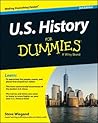 U. S. History for Dummies by Steve Wiegand
My rating: 3 of 5 stars