Book Review: Radical Cartography
Due to my longstanding love of maps, I recently read the eBook version of Radical Cartography: How Changing Our Maps Can Change Our World written by William Rankin and published by Penguin Random House in November 2025. Rankin is a professor at Yale and maintains a website of his mapping projects, which inspired the book. Rankin covers seven aspects to maps — boundaries, layers, people, projections, color, scale, and time — while explaining the meaning of radical cartography, its history, and how cartographers can create maps that make people think.
Part of Rankin’s process in revealing the history of maps was sharing the names of other cartographers, especially those who deserved greater recognition. His introduction began with the story of William “Wild Bill” Bunge, who was credited with a map called Where Commuters Run over Black Children on the Pointes-Downtown Track. While on the surface, this seemed like a map for the noble cause of creating safer urban communities in Detroit, Bunge had actually taken credit for work mostly done by Black teenager Gwendolyn Warren and was known for his racist and sexist language. In the words of Rankin, “The man was a disaster.” Meanwhile, Warren has been honored by the American Association of Geographers (AAG) for her pioneering work. Other famous cartographers introduced new vocabulary to the field. French cartographer Jacques Bertin coined the term monosemy from Greek for “single meaning", another term for clarity or a lack of ambiguity. This was the basis of Rankin's thesis: mapmaking is an inherently biased act, and rather than trying to create an impossibly objective map, one should embrace "the fallibility and idiosyncrasies of data" as the basis for exploration.
The first idiosyncrasy explored by Rankin was the use of boundaries. In the late 19th century, W.E.B. Du Bois created a map to show were different socioeconomic classes of African American lived in Philadelphia, PA. This work supported his “Talented Tenth Theory” that a tenth of Black Americans would become leaders, while the rest were at risk of remaining in the “vicious and criminal classes”. In Chicago during the 1930s, academic mappers Ernest Burgess and Vivien Palmer created maps showing the racial-ethnic segregation of Chicago neighborhoods. The boundaries drawn then still used today, although the borders no longer align to the population.
The second idiosyncrasy was layers, or the hidden-in-plain-sight background of maps. Rankin shared the fascinating story of twenty-seven-year-old Inuit Tapirisat activist Tagak Curley who worked with anthropologist Milton Freeman to create the Inuit Land Use and Occupancy Project report published in 1976, which included maps showing where hunters and fishers, usually adult men, harvested their food. This led to his nation receiving $1.15 billion CAD and the territory of Nunavut in order to continue their traditional lifestyles. Because the modern Western concept of land ownership was so different than Inuit ideas, a map created by the Canadian government alone would not have correctly explained what kind of territorial control would best suit both parties.
I have less to say about about the third chapter, although I did appreciate the inclusion of Edward Tufte, a data visualization specialist with strong opinions on maps and PowerPoint. Chapter four spoke extensively about map projections, especially a terrible projection popularized by German historian Arno Peters and actually created by Scottish theologian James Gall about a hundred years earlier. For me, the fifth chapter about color was much more interesting, as Rankin detailed how Boston-based painter Albert Henry Munsell created the Munsell color system in the early 20th century by painting on a globe "borrowed" from his son, which ensured that all the colors in the system had a natural gradient from light to dark.
While I enjoyed the sixth chapter describing scale, I had not much to say about it except for its introduction to Richard Saul Wurman, the founder of TED Talks, which Rankin seemed not to enjoy due to their brevity and tendency to “simplify complex topics”. Moving along to the seventh and final chapter on the use of time in maps, I was happy to see the names of favorite innovators in the increasingly diverging fields of infographics and film: Eadweard Muybridge, whose photographs of a galloping horse were the basis of film, and Charles Joseph Minard, whose diagram of Napoleon’s failed attack of Russia in winter has been a favorite of many data visualists. Modern references to time used in maps include the widely shared timelapse video hosed by SlaveVoyages.org, and the “Worst Hurricane” map drawn by cartoonist Randall Munroe for XKCD.
Throughout the book, Rankin showed the process of mapmaking and map reading in a different light. Instead of viewing them as “crisp, clear, and unambiguous”, maps should be recognized for their errors. Because mapmakers and map readers are inherently subjective, they should acknowledge this subjectivity by "highlighting disagreement or showing multiple answers to the same question". Rankin constructed a cohesive argument that mapmakers of any political persuasion could consider, even though radical cartography is often considered “left-wing”. This book is written in straightforward language at the university level. Although the sentences are easy to parse, people who do not have a background in cartography or media studies may find themselves confused by the dense content. The beautiful maps throughout the book do a great job illustrating the point and providing breaks to process ideas. I recommend this book to those interested in the recent history of mapmaking, along with seeing a roadmap for where maps are going.
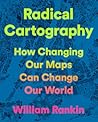 Radical Cartography: How Changing Our Maps Can Change Our World by William Rankin
My rating: 4 of 5 stars