Book Review: The Birth of the West
I recently read The Birth of the West: Rome, Germany, France, and the Creation of Europe in the Tenth Century by Paul Collins, published in 2013 by PublicAffairs. I read from the eBook version on the Libby app, which allowed me to make 1378 highlights in the book. I will only share a handful with you today. At nearly 500 pages in its print addition, and nearly 1500 in digital, this book is not for the faint of heart but rewarding for those interested in learning more about this century of the European Medieval Period, a time of violence and disorder after the fall of the Roman Empire and before the Roman Catholic Church dominated the government.
The book is divided into sections covering 10th century history by country, important people, and the lives of everyday people. The stories were comprehensive and genuinely entertaining, although the location-based format was difficult for me to follow due to the overlap of monarchies, with rulers of several countries being cousins or brothers-in-law. The book really shone where Collins described the accomplishments of people who were famous in their day but might not get a mention in a history class, while learning about the lives of everyday people was my favorite part. Here is a summary of what I learned.
Important people of the 10th century tended to be kings, queens, and popes. In the Holy Roman Empire, a family of men called Otto took the throne, beginning with Otto I the Great. His son, Otto II, inherited the role at age sixteen alongside his teenage wife, Theophano of the Byzantine Empire. The couple was known for their intelligence, along with the equality in their marriage and love for one another. Unfortunately, both died young: Otto II at twenty-eight and Theophano in her early thirties. Our modern use of forks while eating and bathing every day comes from Theophano. The Frankish Empire had many shared names among the Carolingian line, or those descended from Charles Martel. These include the name Pippin (I the Hunchback, II of Aquitaine, and III the Short) and Charles or variations (I Martel, Charlemagne, Carloman I, Carloman II, II the Bald, the Fat, III the Simple). Nicknames were abundant, with rulers including Ingvar the Boneless, Harold Fairhair, Eric Bloodax, Hugh the Great and his son Hugh Capet (the Cape), and Rolf the Walker (who was too big to ride a horse). My fellow fans of The Lord of the Rings will recognize names like Odo, Paladin Roland, and Drogo as those used by Hobbits.
The hierarchy of the 10th century was strict, and yet more flexible than the modern person may imagine. Collins emphasizes that our current understanding of feudalism (which I have discussed at several points in the blog) does not match what people understood in the time period. The concept of a vassal ruling a fief and serving a king was too straightforward for the chaos and near anarchy of most areas. Early 20th century historians like François-Louis Ganshof in his book Feudalism (1944) and Marc Block in his book Feudal Society (1939) tried to explain the system but ended up oversimplifying and romanticizing it. Additionally, the caste system which existed under hypothetical feudalism varied greatly depending upon location. Saxon society had three ordines or castes. The lowest caste at the base of the social period was peasantry, which was subdivided into three categories: serva or unfree serfs, also known as bondmen; coloni or free people who could work a specific piece of land, and liberi or free people who could inherit land. Above them were ranks of nobility and kings. At the top were clergy and bishops of the Catholic church. Outside of the caste system were lazzi or indigenous British Islanders who functioned similarly to “untouchables” in the Hindu caste system. Every level of society was beholden to the level above and subject to heavy taxation, along with needing to ask permission to change any aspect of their lives, especially marriage and relocation. Intermarriage between castes was forbidden. The silver lining to the situation was that women had agency, allowing them to participate in the economy and delay marriage until their mid-twenties if desired, while men could rise in social rank by becoming priests.
Religion was the most important aspect in the lives of most people, but their ideas about their faith were radically different than today. Pagan beliefs and “popular religion” melded with Christian doctrine. At the beginning of the 10th century, the average person saw no issue with animism or the worship of nature spirits along with sacrifices to Norse gods and weekly Sunday service attendance. Strangers visiting a new village had to take care, as some were mistaken for “sky sailors”, sorcerers from the magical land of Magonia who stole food. Pilgrimages to see holy sites and reliquaries, or body parts of saints, were the closest thing most people had to a vacation.
On the Iberian peninsula, which had a predominantly Muslim population, along with a high number of Jews, Mozarab Catholics, and Visigoth or non-trinitarian Christians, people of Abrahamic religions lived together in uneasy peace. Unfortunately, a small number of Mozarabs committed jactatio, or insulting Muhammad to be martyred by the baffled and reluctant Islamic policing forces. By the end of the century, belief had changed as the Catholic church became more powerful and stricter. Theophano of the Byzantine Empire introduced devotion to the Virgin Mary to the Holy Roman Empire, which spread through the West. A few cults sprang up near the millennium, as some believed the end of the world was coming, but these heretics were quickly shut down. The monastic emphasis on sitting in silence with one’s thoughts gradually spilled into the secular population, and western individuality began to take shape.
Societal feelings about nature were different from today, not only because some aspects were worship, but also because it was rarely found beautiful or romantic. The treatment of the natural world was largely utilitarian, with kings and nobility assigning forests as their own hunting grounds. More of Europe was forested than today, and the medieval warm period was encouraging plant growth. People also knew how to plant tree plantations to replace forests that had been cut down. A true wilderness was rare and feared as demonic.
Everyday life was drab by modern measures. A wide range of foods existed: bread, beans, meat, dairy, roots, vegetables, fruits, and eggs. However, most people were too poor to afford these basics and lived on beans, peas, and lentils. Clothing was brown, gray, or red, with outer garments never washed, but at least underwear was washed regularly. By the end of the period, wealthier people had colorful, embroidered garments inspired by the Byzantine Empire. Literacy was low, as even the highly intelligent emperor Charlemagne never learned to write, although he could read, and Vikings had to writing system. Becoming literate became a path to upward mobility as the Church grew in power.
The Church was also responsible for changing Western understanding of friendship, like in part as a response to Islamic beliefs. At the beginning of the period, an amicitia or friendship pact between kin or rulers kept order during times of anarchy, especially among Carolingian Franks. Vassals were expected to kiss the feet of their ruler, while monks wrote lengthy letters and poems using language that sounds romantic to the modern reader. Young rulers kept familiares or intimate advisers and referred to each other as anima mea, meaning "my soul", similar to the modern term "soulmate". It was socially acceptable for young men to wear each others clothes, share the same utensils while eating, hold hands, hug, and kiss in public. At the same time, homosexuality was taboo, and medieval chroniclers were shocked to find a more lax attitude among Muslims in Al-Andalus, now modern Spain. Wealthy men kept harems of both girls and boys; at least one enslaved Christian boy was known to have been executed for attacking a man who wanted to add him to a harem. Near the end of the period, panic spread about epidemics of gay monks, which sounds like an HBO show waiting to happen, and displays of affection began to shift towards modern sentiments. Little is written about friendship between women of this period, or at least, little appeared in this book.
Finally, I appreciated the extensive bibliography at the back of the book. As is often the case, my book list grew longer rather than shorter after reading. I also appreciated the acknowledgement that “much source material for the book was available either in major libraries or on the Internet”, an accessible approach to studying history. The Birth of the West is not for everyone due to its content and confusing method of presentation, but for those who want an in-depth yet approachable look at the 10th century in Europe, there is no better reference source.
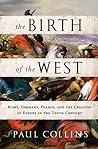 The Birth of the West: Rome, Germany, France, and the Creation of Europe in the Tenth Century by Paul Collins
My rating: 4 of 5 stars